Completed Projects
Diversity and Hybridization of Beringia Whitefish
We conducted a review of whitefish diversity and hybridization in the Beringia region. Genetic diversity and hybridization of whitefish species is largely unstudied, and because these fish are highly important to the food security of Indigenous and rural residents, collecting further information is important in order to make inferences about the adaptation potential and resiliency of these fish. This will be especially critical given changing seasonal cues, water temperatures, and habitat conditions due to climate change and increased human development in the area.
Objectives:
- Collect observations of hybrid whitefish or whitefish with odd morphology from Northwest Alaska fish biologists and subsistence fishermen
- Review scientific and traditional ecological knowledge information for observations or information on whitefish hybrids
- Assess whether the occurrence of hybrid individuals is changing over time
•Collect relevant genetic data and explore ecological outcomes of hybridization
Partners/Funding:
This work was conducted in partnership with Dr. Mac Campbell and Professor Andres Lopez at the University of Alaska Museum of the North. Additional collaborators include Alex Whiting (Native Village of Kotzebue), Bill Carter (Selawik National Wildlife Refuge), and Randy Brown (USFWS). Funding was provided by the North Pacific Research Board and the U.S. National Park Service Lagoons Vital Signs Monitoring Program

Results and outputs:
Overall, hybridization appears to occur between Coregoninae species at a low level, with no evidence of recent increases or decreases in prevalence. This knowledge is important to establish, in the event that changes in hybridization rates occur under climate change scenarios, which could effect the quality and availability of whitefish for subsistence harvesters.
A scientific article was published from this project and is available to read free of charge at the link here. A conference poster was also produced and can be viewed or downloaded here.
Contaminants in Arctic Coastal Fishes of Subsistence Importance
Background: PFAS (synthetic chemicals widely released in the environment) and mercury are ecological contaminants that have not been well-assessed in the Alaskan Arctic previously. These contaminants can bioaccumulate in wild-harvested foods such as fish. Many fish species in coastal Arctic Alaska are harvested by Indigenous and rural residents, and thus there is a concern about potential contamination of fish being consumed
Objective: Assess concentrations of PFAS and mercury in muscle tissue of fishes of subsistence harvest importance in the Chukchi and Beaufort Seas
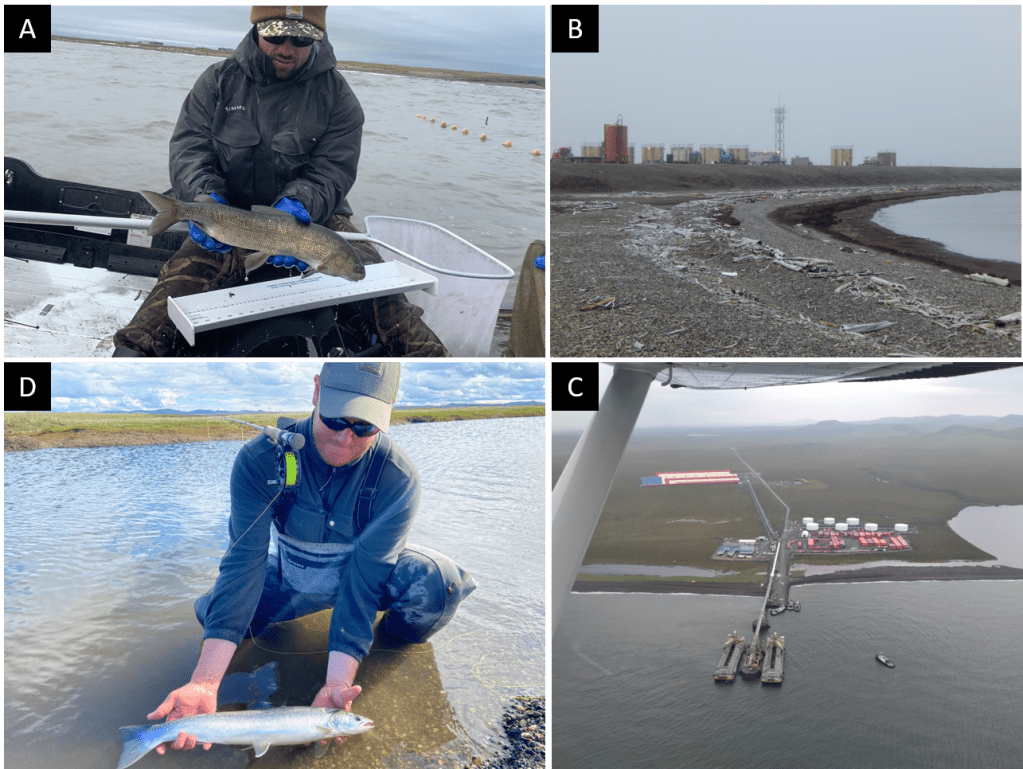
Results: PFAS was detected at very low levels in the muscle tissue of fishes from both the Chukchi and Beaufort Seas. Total mercury concentrations in fish muscle tissue were below human health advisory levels. Read the full results in the scientific article at the link here, and check out this article geared towards the public that summarizes findings.
Partners/Funding: This work was conducted in partnership with Professor Trent Sutton and Carolyn Hamman at the University of Alaska Fairbanks. Additional collaborators include Alex Whiting (Native Village of Kotzebue) and Tahzay Jones (NPS). Funding was provided by the Western Division of the American Fisheries Society and the U.S. National Park Service Lagoons Vital Signs Monitoring Program
 Arctic Beringia Fish Ecology